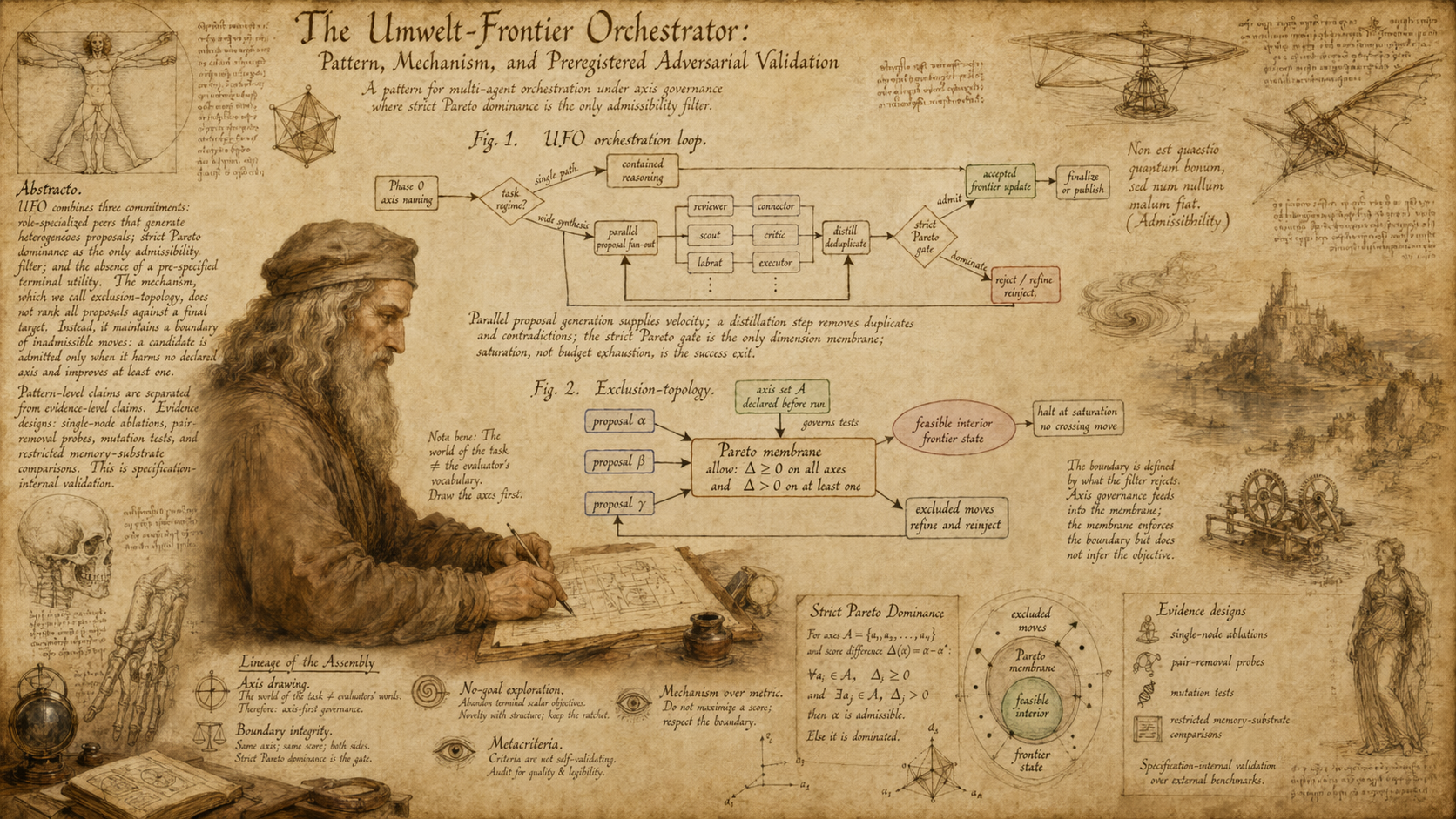
Velocity
Heterogeneous proposal fan-out across symbolic, UI, and shell action channels — including directional navigation that resolves to arrow keys. Table 1 row 1: the GTA jetpack motif marks proposals that escape local optima by crossing novelty-rich transition regions while preserving admissibility.
Umwelt / Axis Governance
R2 codifies axes declared externally: environment state, risk surface, and objective framing. A revolving boundary tracks permitted directions, functioning as the exclusion membrane that filters context drift while preserving the agent’s operational topology.
No-goal Search
Inputs become proposals, not commands. The run explores admissible variants without collapsing them into a single terminal objective.
Pareto Filter
R1 enforces a strict dominance gate. Cursor motion with analog wobble serves as perturbation search; when movement lands in the admissible set, visual ripple marks acceptance—an operational test for non-dominated progression.
Mutation Testing
Mutator probes inject adversarial perturbations across state channels, analogous to matrix-rain stress sequences. At 76.9% kill rate, these sweeps validate robustness by forcing transitions that challenge brittle trajectories before deployment.
Saturation Exit
R4 triggers saturation-based exit when no admissible move crosses the exclusion boundary. Rumble-to-whip-to-border transitions encode the signal: search front saturated, axis redefinition or higher-order perturbation required.